Claims portfolio review & management
Where most engagements start
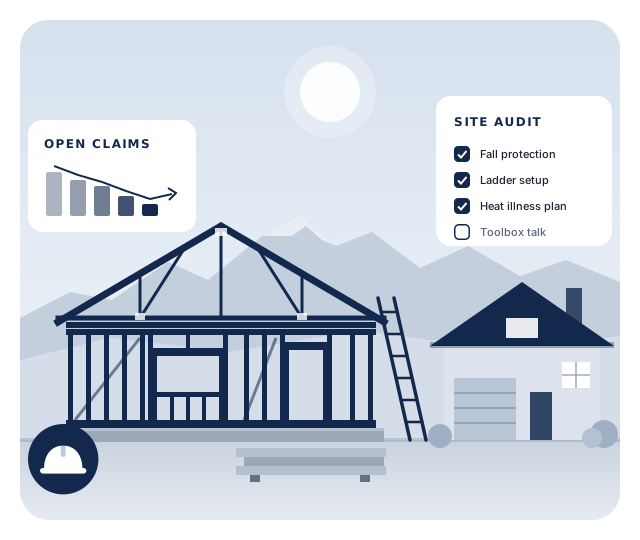
We review every open claim, challenge reserves with the adjuster and drive stale claims to closure before the valuation date that sets your mod.

Construction safety & claims consulting
West Consulting works with residential and commercial subcontractors in California and Nevada on the two things that drive insurance cost: the claims already open, and the injuries that haven't happened yet.
Services
Nobody buys a safety program because it is a good idea. Contractors call the week something forces the question. Engagements run from a one-time portfolio review to ongoing retained advisory.
Where most engagements start
We review every open claim, challenge reserves with the adjuster and drive stale claims to closure before the valuation date that sets your mod.
Timed to your valuation date
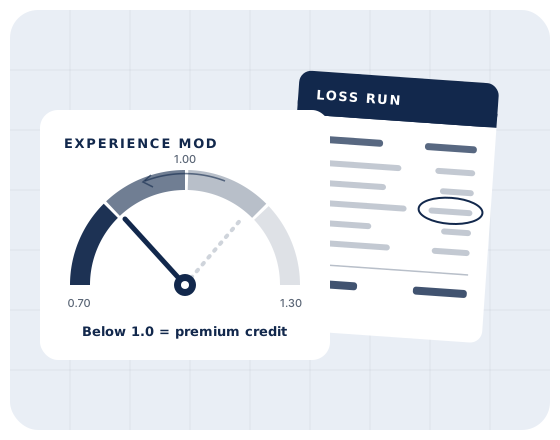
Your mod is arithmetic, and the worksheet shows the inputs. Most we audit carry at least one misapplied payroll classification or one claim valued at a reserve that no longer matches reality.
The most time-sensitive work we do
Most contractors abate correctly and document it badly, then pay the full penalty anyway. The informal conference turns on the package, not on the fix.
Assess, build, train, hand off
A written program nobody trained on is worse than no program, because it proves you knew the standard. We deliver the program, the training that makes it real and the records that prove both.
Retained on your renewal cycle
In a group captive, every open claim is your own money sitting in the frequency fund. Claims management stops being an insurance task and becomes a treasury task.
Most engagements continue after the first project. Retained clients get a monthly claim review with written reserve and closure commentary, direct engagement with the adjuster, quarterly loss analysis by entity and division, renewal and captive meeting preparation, and a call when an inspection or incident happens.
Talk about a retainer →When to call
Most of the leverage on your insurance cost sits inside a few windows. Miss them and the number is set for another year.
The only window where anything can still change the submission your broker takes to market.
The last point where closing a claim still moves your next mod. Most contractors do not know this date.
You have 15 working days to contest in both California and Nevada. The documentation you build in the next two weeks matters most.
Getting the investigation, the first report and the return-to-work plan right in the first days shapes the claim for years.
A GC's EMR gate at 1.00 turns an abstract number into lost revenue overnight.
A California contractor taking Nevada work, or the reverse, faces a different OSHA authority, comp system and mod.
Loss cost lands on a specific date, and every open claim is counted against the fund.
Mods, classifications and programs all have to be rebuilt, and nobody inside has the time.
Why West Consulting
No junior auditor with a checklist. The person who walks your site and reads your loss runs is the person who signs the findings.
Safety firms stop at the program. Claims consultants stop at the adjuster. Your mod is made of both, and the handoff between them is where money leaks.
Different OSHA authority, different comp systems, different rating bureaus and separate mods. We know where the line falls.
Multi-entity groups, combined and separate mods, frequency fund mechanics and refund timing: the conversation that matters most to an owner.
Who we work with
Production and custom home trades with high-frequency exertion, slip, trip and fall exposure.
Ground-up commercial, tilt-up and data center work with heavy lifts, work at height and tight schedules.
Crews working both sides of the state line, with two OSHA programs, two comp systems and two mods.
Several operating companies or divisions whose loss data has never been cut apart.
About the firm
West Consulting LLC is an independent safety and claims practice based in Gardnerville, Nevada, serving residential and commercial subcontractors in California and Nevada. We are not a broker and we are not paid by a carrier or TPA, so there is no commission and no conflict.
We are not a full-time safety manager either. We work alongside whoever owns safety inside your company and take on what one person can't do alone: the portfolio view of the loss data, the claims side, and documentation that holds up in front of a compliance officer.
Representative engagement
Our longest-running engagement is a multi-entity construction group operating in California and Nevada: residential and commercial subcontracting, several operating companies, all members of a group captive. We manage the claims portfolio across the entities, analyze loss data by division, and produce the safety programs and training the field actually uses.
We don't name clients. Yours would get the same treatment.
Questions
A loss control visit is a report to the carrier about you. It is useful, and we'd want to read it. What it won't do is call your adjuster and argue a reserve down, build the abatement package after a citation, or sit on your side of the table at the captive meeting. If your broker is doing those three things, you don't need us, and we'll tell you so.
Good. The engagements that work have someone inside who owns safety. We are not a replacement. We handle what one person can't do alone: the portfolio-level look at the loss data, the claims side, and documentation that has to hold up in front of a compliance officer. Your safety manager usually ends up our best ally.
No, and be careful with anyone who does. Your mod is arithmetic on claims already reported. What we can do is show you which open claims are still costing you, which payroll classifications are misapplied, and which exposures are generating the frequency that sets next year's number. We show you that math before you spend anything more.
The closed claims are locked. The open ones aren't. Anything still open is counted at its reserve, not at what it will eventually settle for. Closing a handful of stale claims before your valuation date can move a mod more than a clean year in the field.
A program nobody trained on is worse than no program, because it proves you knew the standard. We deliver the written program, the training that makes it real and the records that prove both. At the end of every phase, ask us what a compliance officer would ask for, and we'll show you the file.
Loss control exists to price your risk and document the carrier's file. The adjuster manages the claim inside the carrier's interest, which is not always closing it. Neither of them works for you. That gap is the whole practice.
That is when injuries happen: more crews, more new hires, more overtime. The first phase is desk work with your loss runs and mod worksheet, and it doesn't cost you a superintendent's hour.
Get started
The useful first conversation happens with your data open. Send what you have and don't worry about what's missing:
We'll come back with what we're seeing and what we'd propose. If we can't move your numbers, we'll tell you that instead.